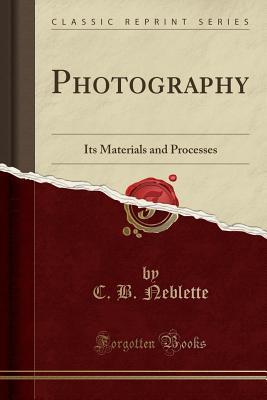
Download Photography: Its Materials and Processes (Classic Reprint) - C B Neblette file in ePub
Related searches:
Photography : its materials and processes - Edinburgh University
Photography: Its Materials and Processes (Classic Reprint)
Photography, a Handbook of History, Materials, and Processes
Print and Photograph Materials - YouTube
Photography, Its Materials and Processes : Neblette, Carroll
Photography : its history, processes, apparatus, and
50 Types of Photography Most Popular Styles and Categories
A Brief History of Photography and the Camera
Technology of photography - Black-and-white processing and
Best Way To Print Art And Photography - Tribeca Printworks
The Art of Mounting and Framing Photos - Photography Spark
Complete Guide to Black and White Photography
Photography and Copyright Law
Photography and Other Media in the Nineteenth Century Edited by
The power of photography: time, mortality and memory Art
Photo-curing 3D printing technique and its challenges
1020 3378 3739 1025 3735 2054 788 4292 1397 1818 2957 4566 3935 1703 1468 2520 618 905 1745 1245 3918 1450 3465 2539 1336 3311
Photography is the method of recording an image of an object through the action of light, or related radiation, on a light-sensitive material. History of photography, the treatment of the historical and aesthetic aspects of still photography.
The sculptor, brancusi, believed that his art should contain a truth to materials in which an artist would coax an image from within the material rather than forcing.
Photography, as we know it today, began in the late 1830s in france. Joseph nicéphore niépce used a portable camera obscura to expose a pewter plate coated with bitumen to light.
Again, you don't need a large budget to create polished and professional product photos.
Their essays look at the emergence and early history of photography in the context of broader changes in the history of communications; the role of the nascent.
Although fujifilm had already begun to diversify its portfolio of technologies, photographic film had remained the company's bread and butter since its founding.
The core of photography is a camera, or at least the sensor of a camera. At the moment, one of the biggest debates in the photography world is between two different types of cameras: mirrorless and dslr cameras. Both have their merits, but a beginning photographer on a tight budget should be looking more closely at dslrs.
The digital imaging unit at the center for creative photography (ccp) utilizes a host of different types of technology and equipment in its digitization efforts:.
What makes photography a strange invention is that its primary raw materials are light and time.
Film photography dates back to the late 1800s and is the precursor to digital photography. “safety film” was introduced by kodak in 1908, although previous iterations of film were used as early as 1889, but were made from the much more flammable material, nitrocellulose — usually referred to as “nitrate film”.
Pornography, representation of sexual behaviour in books, pictures, statues, motion pictures, and other media that is intended to cause sexual excitement. The distinction between pornography (illicit and condemned material) and erotica (which is broadly tolerated) is largely subjective and reflects changing community standards.
Photography has come a long way in its relatively short history. In almost 200 years, the camera developed from a plain box that took blurry photos to the high-tech mini computers found in today's dslrs and smartphones.
Subsequent innovations made photography easier and more versatile. New materials reduced the required camera exposure time from minutes to seconds, and eventually to a small fraction of a second; new photographic media were more economical, sensitive or convenient.
In its molten form, the emulsion is coated onto a support structure, usually a polymeric film. The original film used by eastman was made from cellulose nitrate and was extremely flammable. Modern film uses solvent-based materials, like cellulose triacetate, and extruded materials, like polyethylene terephthalate.
The idea was to use normal linen fiber-base paper and coat it with a plastic (polyethylene) material, making the paper water-resistant. The problem with resin-coated papers was that the image rides on the plastic coating and was susceptible to fading.
Photography� its history, processes, apparatus, and materials� comprising working details of all the more important methods item preview.
A photograph is an image made by a photo-chemical reaction which records the impression of light on a surface coated with silver atoms. The reaction is possible due to the light-sensitive properties of silver halide crystals. In 1556, the alchemist fabricius was the first to discover that light can photochemically react with these crystals to change the silver ions (ag+) to elemental silver (ago).
Infused with references to both the german romantic tradition and its political and philosophical heritage, these large-scale works meld painting with collage and sculpture, combining a nearly monochromatic painter’s palette with unorthodox materials, such as lead, wire, straw, plaster, mud, seeds, sunflowers, ash, and dust.
Dec 18, 2018 print and photograph materials gives a basic overview of the variety of processes and materials used to your browser can't play this video.
Oct 29, 2016 a tripod is also an essential piece of equipment, since it can help you keep your camera steady and allow you to take many pictures of each.
Something to do with time and mortality and memory, all the things roland barthes wrote about in camera lucida, and which photography seems to evoke like no other art form because of its very.
Reactive matters: photography and nuclear materials to reveal its direct impact on our environment, artists jeremy bolen, abbey hepner and shimpei.
Apr 20, 2020 a well-designed combination of frame, mount, and mat forms part of the visual expression of a displayed photo, separating it from its surroundings.
Apr 17, 2020 there are countless surfaces and substrates that you can print your work on ranging from traditional art and photographic papers to aluminum,.
Title statement, [photomechanical plates in photography: its history, processes, apparatus, and materials].
Photography is the art, application, and practice of creating durable images by recording light, either electronically by means of an image sensor, or chemically by means of a light-sensitive material such as photographic film.
Autoprocess materials; applications; special photosensitive systems. Electrophotography; colloid and photopolymer processes; diazonium processes; photochromic systems; electronic photography; special techniques and applied photography. High-speed shutters; high-speed light sources; synchronization; stroboscopic photography.
There are three broad types of film-based photographic materials: cellulose nitrate, cellulose acetates, and polyester.
Raw materials a roll of film consists of the emulsion and base that compose the film itself, the cassette or cartridge, and outer protective packaging. The materials used to make the emulsion are silver, nitric acid, and gelatin. The base consists of cellulose and solvents that are mixed to form a thick fluid called dope.
Since its invention in 1839, photography has served as a medium for documenting, understanding, and interpreting the world. It has radically contributed to the evolution of visual representation, in part by allowing for the documentation of a moment in time, and, because of its inherent reproducibility, by enabling the wide circulation and distribution of images —which has exploded with the advent of the internet and social media platforms.
For beginners or more advanced students, this text gives step-by-step insruction to the various basic procedures and advanced techniques in photography.
Apr 11, 2020 this introduction to photography is written for beginners, with several tips and suggestions to take your skills as far as possible.
Invention: the daguerreotype (first commercial photographic material) where: france, 1839; impact: daguerreotypes are images fixed directly to a heavily polished sheet of silver-plated copper. This invention is what really made photography a practical reality – although it was still just an expensive curiosity to many people at this point.
The same is true in landscape photography, in which case a golden sky can draw the entire image upward. In both cases, you would need to compose your photo differently if you shot in black and white instead – and these are far from the only examples.
Mar 10, 2021 ryan harvey, david alan harvey, martin parr and friends.
There are few sadder sights than a beautifully framed photograph that bends toward its glass on account of inadequate backing. You want to choose a material that will keep your image parallel to the wall. It is important to know that temperature and humidity are capable of increasing the risk of your mounting material warping over time.
“what makes photography a strange invention is that its primary raw materials are light and time.
Mar 23, 2020 share your best marketing tips for photographers - here are things to help your photo business grow.
Your feedback and communication is key to a clients experience and the outcome of your photographs. Here are some tricks to help your clients relax and produce.
Post Your Comments: