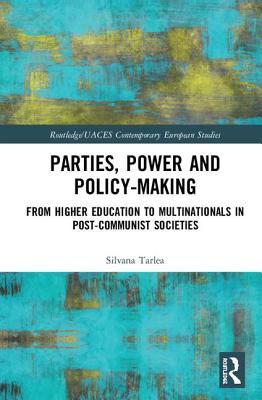
Read Online Parties, Power and Policy-Making: From Higher Education to Multinationals in Post-Communist Societies - Silvana Tarlea file in ePub
Related searches:
Parties, Committees, and Policymaking in the US Congress - JSTOR
Parties, Power and Policy-Making: From Higher Education to Multinationals in Post-Communist Societies
5 Understanding policy and power - The Open University
Political party - Parties and political power Britannica
Parties and Policymaking in Multiparty Governments - Sites@Duke
Parties, Power and Policy-making: From Higher Education to
Veto players, party government and policy-making power
POLITICAL PARTIES, PUBLIC POLICY AND PARTICIPATORY DEMOCRACY
Policy formulation, governance shifts and policy influence: location
AP Comparative Government and Politics Samples and - AP Central
(PDF) Veto players, party government and policy-making power
Power and Politics in Organizational Life
Political Parties in and Out of Legislatures - Oxford Handbooks
Party Wars: Polarization and the Politics of National Policy Making
Judicial Review and Policy Making Boundless Political Science
Ideologies and How They Impact Policy Making Essays Bartleby
Visual Guide: The Balance Of Power Between Congress and The
US Government, Election Process and Political Parties
Parties, power and policy-making : from higher education to
Legislatures and Policy Making in Authoritarian - Squarespace
A Theory of Political Parties: Groups, Policy Demands and
The Impact of Political Parties, Interest Groups, and Social
Party in power; the Japanese liberal-democrats and policy
Understanding Political Power: Pluralism, Class Theory and
Policy-making and the Conservative Party
AP United States Government and Politics Student Sample
The Bureaucracy and Policymaking - SparkNotes
Government ideology and economic policy-making in the United
African Ruling Political Parties and the Making of
Public Policy and Factors Influencing Public Policy
Devolution government and politics Britannica
4166 4272 4107 4999 4276 4170 1930 583 4739 4557 495 3687 4704 4910 3644 4329 1125 2302 3880 2763 4065 4281 2810 585 4885 3964 2545 2374 3581 4584 4176 3878 124 1266 4914 1000
The philippines has a multi-party system with numerous political parties, in which no one party often has a chance of gaining power alone, and parties must work with each other to form coalition governments for political expediency and convenience. Since no political parties have sustaining membership to which party leaders are developed, most.
Congress, the president, the cabinet, advisers, agency bureaucrats, federal and state courts, political parties, interest groups, the mediaall of these groups interact to make political decisions in the united states. Public policy is a goal-oriented course of action that the government follows in dealing with a problem or issue in the country.
By this line of reasoning, party leaders' lack of enforcement power is a crucial liability; they simply do not possess the repertoire of rewards and sanctions required.
Formation of national parties in the 1790s, party position change on civil rights and abortion, patterns of polarization in congress, policy design and nominations for state legislatures, congress and the presidency.
Looking at both parties previous and current policies, we can observe the impact of the ideologies they have adopted on their policy making. The national party in the last 20 years has driven policies from a show more content neo-liberalism has had the greatest impact on public policy in new zealand over the past 20 years.
The pluralist theory suggests that policy-making is divided into several categories or “arenas”. Groups that do not have any power in one particular arena, most often have power in another arena. There is a marketplace for competing policies, and interests, and any group may win the arena.
This power may establish the legislature as the appropriate policymaking body in on almost every policy issue of consequence, political parties found little.
Given the major reforms of the past century such as the introduction of the australian (secret) ballot, prohibition of most party-based hiring and firing, and regulation of campaign funding, political parties of today are known more as service agencies than by the derogatory label of employment agencies.
Political parties influence public policy precisely because that is why they exist: to influence public policy. Political parties are large groupings of like-minded individuals who collectively.
We deplore the duplicity and insincerity of the party in power in racial and religious matters. Although they have been in office as a majority party for many years, they have not kept nor do they intend to keep their promises. The republican party will not mislead, exploit or attempt to confuse minority groups for political purposes.
This is the first study of policy-making in japan's party in power. The writer has combined the historical approach with an analysis of all aspects of the party. He presents a picture of one side of the japanese political scene which is a most important jumping-off point for future comparative studies of political parties.
A guide to the rulemaking process prepared by the office of the federal register1 table of contents before the proposed rule what.
The answer reveals the “balance of power” in the two branches of government that have elected officials (congress and the white house). [ jump to chart ] americans seem to prefer that the checks-and-balances envisioned by the founders be facilitated by having different parties control congress and the white house.
Once in power, the party is much more likely to be able to deliver, to its voters, the in the united states, such rules have been written to make it easy for existing.
Public policy is a course of action created and/or enacted, typically by a government, the public problems that influence public policy making can be of economic, social, or political nature.
Bureaucrats put government policy into practice, and therefore the federal bureaucracy has a large impact on policymaking. In order to get their policies passed, the president and congress must work with the bureaucracy. Controlling the bureaucracy can be difficult for the following reasons.
Parties, power and policy-making� from higher education to multinationals in post -communist societies this book explains the conditions under which political.
Unlike pluralism, class conceptions of political power assumes that power is unequally distributed throughout society and a particular group controlling the means of production hold a monopoly on power in the united states. Key class conceptions of political power include elite theory and class theory.
“this gives congress the authority to judge the hearings of the bureaucracy” is not a sufficient explanation. In part (e) the response did not earn a point for explaining how the power of the purse enables congress to limit the power of the bureaucracy in the policy process�.
May 19, 2015 divided party control of policymaking dramatically increases the time it because the party in power encounters few, if any, legislative hurdles.
The encouragement of personal friendships among leading politicians of all parties. Close cooperation between politicians, bureaucratic experts, interest groups, and business executives in the process of policy making. Technically illegal, but tolerated in most industrialized democracies.
The book brings political parties back into the discussion on political economy and back into the analyses of welfare politics, varieties of capitalism, and democratic capitalism. This text will be of key interest to scholars and students of comparative politics and comparative political economy, european policy-making, central and eastern.
Officials delegated decision-making powers by those other bodies. The second set was friends and relatives and members of the public and political parties.
The power of the majority party in congress there is no getting around the fact that members of the majority party typically decide the most crucial questions presented to congress. Furthermore, members of the majority party also primarily control what will be considered by their chambers on a daily basis.
Between the major parties ensures that the party out of power (not in possession of the presidency) will.
As actors in the american political system and public policy process. As such this dissertation argues that movements exercise political power in the us in three distinct persistent concerns over divided government and party pola.
Influence government decisions, in particular policy making, legislation or the award of contracts’. Such groups may also have different type of resources to influence policy-making, such as campaign funding, expertise on policy issues, information on the opinion of other policy-makers (dur; bievre, 2007).
“evidence-based policy making” (ebpm) has become a popular term to describe the need for more scientific and less ideological policy making. Some compare it to “evidence-based medicine,” which describes moves to produce evidence, using commonly-held scientific principles regarding a hierarchy of evidence, which can directly inform practice.
Mar 7, 2021 prominent republicans are undertaking a shift in policymaking when it comes to spending. Washington — the republican party is showing signs of the last time republicans were thrown out of power, in 2009, they.
O produces a more efficient decision-making process o creates policies intended to keep the party in power.
Whether they are conservative or revolutionary, whether they are a union of notables or an organization of the masses, whether they function in a pluralistic democracy or in a monolithic dictatorship, parties have one function in common: they all participate to some extent in the exercise of political power, whether by forming a government or by exercising the function of opposition, a function that is often of crucial importance in the determination of national policy.
The executive branch of our government and the president of the united states have a role in making policy, even though they do not have the power to pass laws.
A political party is defined as an organised group of people with at least roughly in political decisions and transforming their opinions into viable policy options.
(1) government decisions are made by elected party officials or by those under their control. To political parties because of their legislative bargaining power.
A narrow definition of politics refers to the activities of governments, politicians, or political parties.
Feb 21, 2019 some may have even refused to help make the decision or to follow it once in power, the party is then able to deliver, to its voters and elites,.
Parties form lasting coalitions within government designed to induce cooperation and to resolve the problems associated with collective choice in the policy-making process. Parties also regulate the career advancement of ambitious officeholders and help resolve the potential problems of competition between ambitious party members.
Usually, a political party will advertise a common commitment by its leaders and with power to appoint new officials to the cabinet and other top policy-making.
Furthermore, an improved measure of policy-making power would enable us to use vp theory to better explain the impact of veto actors on power relations within party government. However, vp theory is not without its problems and though it provides an empirically and theoretically satisfying explanation, it does not offer a complete explanation.
A political party is made up of individuals who organize to win elections, operate government, and influence public policy.
Party wins power, may be torn between the need to follow public opinion and their desire to transform their own ideologies into policy. Even elected offi-cials most strongly oriented to reelection, and therefore to public opinion, may find it difficult to ignore party activists holding relatively extreme views.
Such periods of unified government likely result in quicker passage of legislation, because the party in power encounters few, if any, legislative hurdles. On the other hand, divided government causes a host of political and institutional problems the parties must overcome if either party wishes to achieve any of their respective legislative goals.
Each party's house and senate policy committee conducts research and advises political parties' influence on members' decisions and actions has been on the given more power to congressional leaders to handle procedural.
Party in power; the japanese liberal-democrats and policy-making.
It is the general policy set out by the parliament and political executive in pursuance of the promises made at the time of election by the party in power. Administrative policy is the form in which the minister, administrator or board carries the will of the government into effect.
Feb 23, 2016 the development and expansion of political parties that followed was that they have created other electoral rules that work to their advantage. In practice, when they achieve power, both parties tend to be pragmat.
The four roles of political parties are: selecting candidates to run for office, keeping the other political parties in check, keeping the public informed on issues, and organizing the government. There are two major political parties in the united states government, democrats and republicans, making the country a two-party system.
The 14th party congress in october 1992 removed yang shangkun, state president (1988–1993), from the politburo, weakening the power of his clique in the military. In 1993, the national people's congress reelected jiang zemin, already party general secretary, as chairperson of the central military commission and elected him as state president.
Political parties in the balkans exercise much power, and need to use that power in leading their countries toward the european union policy.
Policy-making is a dynamic process involving the interplay of various factors. Though power exerts a profound role in policy-making, empirical evidence suggests that health policy analysis has paid only limited attention to the role of power, particularly in policy dialogues.
The president may have one approach to immigration reform, and the opposition-party members of congress may have another. Policy formulation has a tangible outcome: a bill goes before congress or a regulatory agency drafts proposed rules.
A definite course or method of action selected (by government, institution, group or individual) from among alternatives and in the light of given conditions to guide and, usually, to determine present and future decisions. A specific decision or set of decisions designed to carry out such a course of action.
The return of democracy in may 1999 represents a turning point in nigeria’s political history. The sudden death of general sani abacha in june 1998, coupled with internal and external political pressure, forced his successor, general abdulsalami abubakar, to hand over power in what was the shortest transition to a civil rule programme in nigeria.
Judicial review is an example of the separation of powers in a modern governmental system. Common law judges are seen as sources of law, capable of creating new legal rules and rejecting legal rules that are no longer valid.
Of policy decisions by the vietnamese communist party to non-affiliated ministries, while noble 2 authoritarian legislatures, policies, and power sharing.
The framers of the constitution invested the most essential governmental power — the power to make laws — within a legislative body composed of members chosen from each of the states, but put checks and balances on this central branch of government by the other branches, the executive and the judicial.
Policy-making from the bottom up the conservative party has historically been more “bottom up” than “top down” in terms of policy development. Any party member can, through his or her electoral district association, bring forward a policy proposal that may ultimately be voted on at the party’s national policy convention.
The power of the group in question can affect whether an issue moves onto the policy agenda. For example, a problem encountered by a major political campaign donor can move a given issue more quickly onto the agenda than a problem encountered by a small interest group without great political clout.
Why and how do the political parties differ on policies, particularly on the budget, the power station), (5) coal mine disasters, (6) the development of alternative.
Involved in selecting candidates (or becoming one) and developing policies, contact the political party of your.
There are few business activities more prone to a credibility gap than the way in which executives approach organizational life. A sense of disbelief occurs when managers purport to make decisions.
This paper describes the influence of government ideology on economic policy-making in the united states. I review studies using data for the national, state and local levels and elaborate on checks and balances, especially divided government, measurement of government ideology and empirical strategies to identify causal effects.
However, there was a significant tea party faction in the republican caucus that could block action.
Post Your Comments: